
The History of Monks’ Barn, Hurley
From Norman Priory to Monks’ Barn
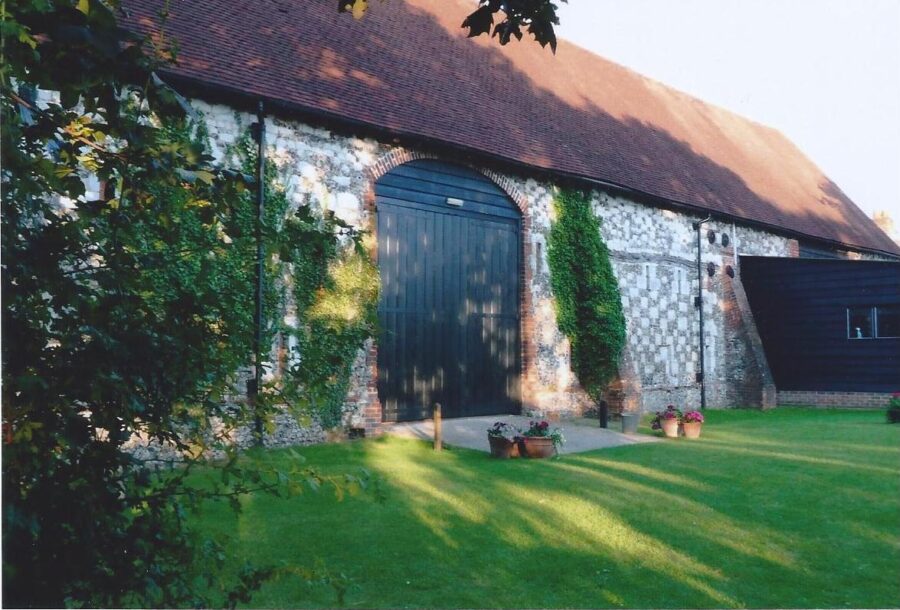
Set in the historic Berkshire village of Hurley, Monks’ Barn is one of the village’s most remarkable surviving medieval buildings. With its flint and chalk walls, vast timber roof and centuries of history, the Barn is a tangible link with the Benedictine monks who once lived and worked beside the River Thames.
Today, Monks’ Barn is best known as a unique wedding venue, but its story begins more than 900 years ago with the foundation of Hurley Priory.
Hurley Priory was founded in around 1086–1087 by Geoffrey de Mandeville, one of William the Conqueror’s most important Norman landowners. Dedicated to St Mary, the priory was established as a Benedictine cell of Westminster Abbey and remained closely connected with the Abbey throughout the Middle Ages.
The Priory became the centre of a substantial monastic estate beside the Thames. Its precinct extended over around 20 acres and included the church, cloisters, refectory, accommodation, agricultural buildings, fishponds and other structures needed to support the monks and their community. Several important remnants of this medieval complex can still be found around Hurley today.
Monks’ Barn originally formed part of this wider monastic estate and was used as an agricultural building associated with Hurley Priory. Large barns such as this were essential to medieval monasteries, providing space to store the crops, grain and produce generated by their surrounding farmland.
A Remarkable Medieval Building
Historic England records Monks’ Barn as a medieval eight-bay barn, constructed principally from chalk, quarry flint and stone likely in the 13th century. Its impressive timber roof incorporates tall queen-post roof trusses, purlins and wind braces.
The use of chalk and flint is particularly characteristic of historic Hurley. Historic England’s study of Berkshire’s traditional building materials highlights Monks’ Barn as one of the village’s important surviving medieval buildings, noting the extensive use of flint alongside chalk dressings, quoins and blockwork.
Other studies of historic barns in East Berkshire have also identified Monks’ Barn as an especially notable example of the area’s traditional agricultural architecture.
Although the exact construction date cannot be stated with certainty, the Barn has medieval origins and has survived through centuries of alteration and changing use.
Life at Hurley Priory
For approximately 450 years, Benedictine monks lived at Hurley.
The Priory was dependent upon Westminster Abbey and its buildings would have supported both the religious life of the community and the practical business of managing a large medieval estate.
The surviving landscape still gives clues to how extensive the monastery once was. Historic England records the remains of the medieval refectory, cloister range, priory walls and fishponds, while the nave of the former priory church survives today as St Mary the Virgin Church.
Nearby historic buildings are also connected with Hurley’s monastic past. The Olde Bell is traditionally associated with the Priory’s guest accommodation, while the medieval dovecote and other surviving structures provide further reminders of the period when the monastery dominated village life.
Monks’ Barn would therefore have been part of a much larger working community rather than an isolated building. For the monks, agriculture was fundamental to everyday life, and buildings like the Barn helped store and protect the produce on which the Priory depended.
The Dissolution of Hurley Priory
That monastic way of life came to an end during the reign of Henry VIII.
Hurley Priory was dissolved in 1536, during the Dissolution of the Monasteries. Westminster Abbey records that the lands of Hurley Priory subsequently became part of a significant property exchange with the Crown.
The former monastic estate gradually passed into private ownership. Much of the Priory itself disappeared or was incorporated into later buildings, although a surprising amount of its medieval fabric survives throughout Hurley.
On part of the former Priory site a mansion known as Ladye Place was constructed. It later became associated with the Lovelace family and remained an important Hurley residence for centuries before being demolished in 1837. Its surviving crypt can still be found within the former Priory site.
Monks’ Barn, however, survived.
Centuries of Agricultural Use
Following the Dissolution, the Barn continued to serve the agricultural community of Hurley.
Historic England’s official listing still records the building under its historic designation of “Barn at Hurley Farm” and confirms that it originally belonged to Hurley Priory.
Its survival is particularly remarkable when so many agricultural buildings have been demolished, extensively rebuilt or converted beyond recognition. The Barn’s enormous proportions, ancient masonry and timber roof still make its original purpose immediately apparent.
It is this combination of architectural survival and its direct connection with Hurley Priory that makes Monks’ Barn such an important part of the village’s history.
A Grade II* Listed Building
Monks’ Barn was formally listed in 1955 and is now protected as a Grade II* listed building. Grade II* is reserved for particularly important buildings of more than special interest, placing the Barn among a relatively small proportion of England’s listed buildings.
The designation recognises not only the age of the building, but also the survival of its historic structure and its importance as part of Hurley’s medieval landscape.
Its eight-bay plan, flint and chalk construction, ventilation openings and imposing timber roof all provide evidence of the building’s long agricultural history.
Monks’ Barn Today
After centuries spent as part of Hurley’s agricultural landscape, sadly a fire took hold of the barn, with the whole barn engulfed in flames. This destroyed the roof and required years of repair work, made more complicated by its Grade II* listed status. Due to the number of potatoes stored in the barn, it was remarked by the local villagers that at least the smell was lovely.
Monks’ Barn has since found a new purpose. Today its great doors, high timber roof, flagstone floors and historic walls provide the setting for weddings and celebrations. Rather than being preserved simply as a monument, it remains a building that is used, enjoyed and cared for.
The Great Hall retains the scale and character that made the Barn such an impressive working building centuries ago, while the adjoining lawn provides an outdoor space in the heart of historic Hurley.
More Than 900 Years of Hurley History
Monks’ Barn’s story is closely intertwined with the history of Hurley itself.
From the arrival of Benedictine monks in the 11th century, through the Dissolution of the Monasteries and centuries of farming, to its role today as a wedding venue, the Barn has witnessed extraordinary changes around it.
Yet much of its medieval character survives.
Standing beneath its huge timber roof today, it is easy to imagine the generations of people who have used the building before us. That sense of continuity is what makes Monks’ Barn such a special place – not simply a historic building, but a living part of Hurley’s story.